
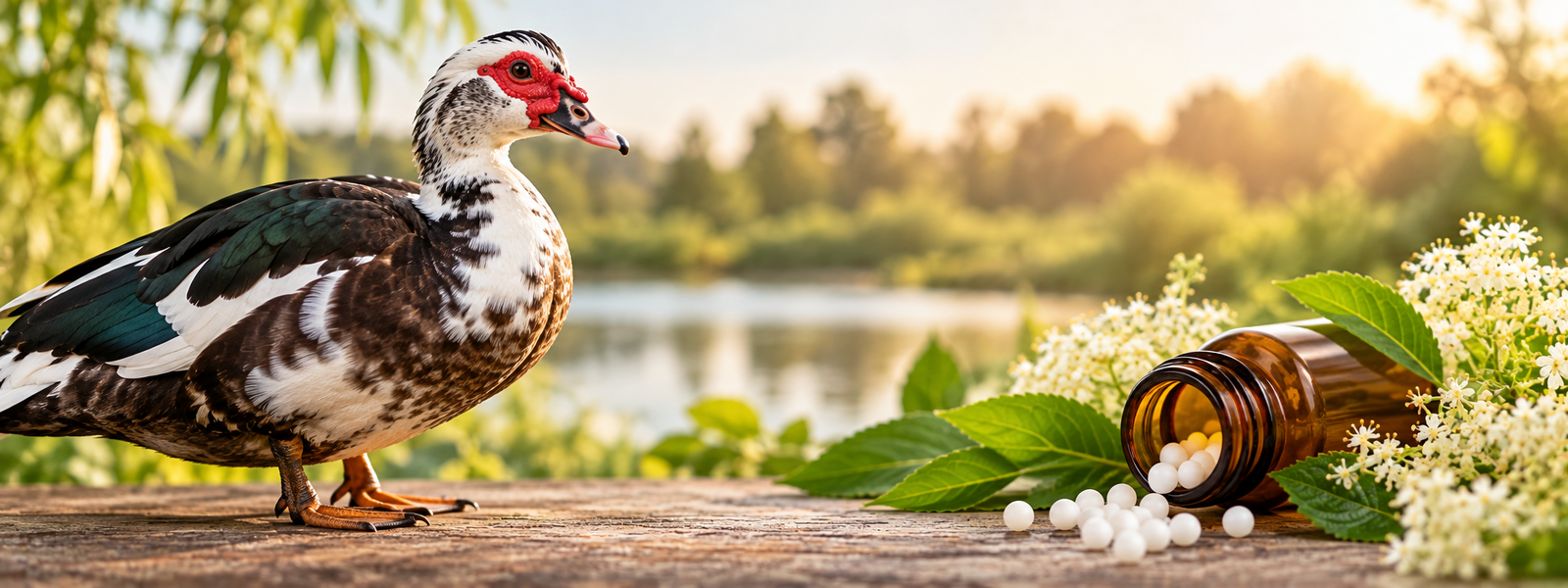
Anas barbariae: A Gift from the Birds for Cold & Flu Season
By Ian Spohn, ND
Article Summary: Anas barbariae is a widely used homeopathic ingredient found in many natural cold and flu products—but its origin and how it’s made may surprise you. Derived from a carefully prepared source material from the Muscovy duck, this unique ingredient requires extensive sourcing, testing and quality controls to meet modern manufacturing standards.
Learn more about the history of Anas barbariae, its role in homeopathic cold and flu support, and the care that goes into sourcing, testing and preparing homeopathic ingredients with quality and traceability in mind.
November is a time when many give thanks, traditionally with friends and family over turkey. But as cold and flu season ramps up, it is another bird – the Muscovy duck – which should be thanked for providing one of the best-selling natural remedies for seasonal symptoms. Though many have taken it for prevention of cold and flu symptoms, few know the source of this popular homeopathic remedy, often sold under registered trade names. Anas Barbariae, Hepatis et Cordis Extractum, as it is officially known, is used worldwide despite the obscure origin of its starting material, which is unusual even for a homeopathic remedy. Made from a unique, sterilized preparation of the heart and liver of a Muscovy duck, to supply this remedy from raw material presents a unique manufacturing challenge.
Certain homeopathic ingredients, including popular cold and flu remedies like Sambucus nigra (elderflower), Zincum Metallicum (pure zinc), and Allium cepa (red onion) are easily obtained from reputable suppliers, often the same suppliers providing the herbal and dietary supplement industry. Contrary to popular belief, dietary supplements are highly regulated and subject to numerous quality control requirements throughout the manufacturing process. Among these is the qualification of ingredient suppliers and testing of incoming ingredients, meaning raw materials are generally supplied with a unique Certificate of Analysis. Individual lots must be documented each time an ingredient is purchased, so affected products may be traced in the event of non-conformance or potential recall. These guidelines, established and enforced by the Food & Drug Administration (FDA), become even more stringent when applied to homeopathic remedies, which are regulated along the same standards as pharmaceutical drugs.
The challenge, therefore, in sourcing homeopathic raw materials is the fact that so many of the substances are obscure, rarely if ever used for anything outside of homeopathy, and therefore difficult to obtain in the marketplace. Anas barbariae fits this category, for despite its reputation as a cold and flu medicine and preventative, the heart and liver of a Muscovy duck is not a typical article of modern commerce. The origin of this unique remedy goes back to the Spanish Flu epidemic of 1918, though it did not become well known to the homeopathic profession until more modern times. The basis of using duck heart and liver can be traced to a dubious microscopic finding which suggested the “germ” of influenza was highly concentrated in the organs of this particular bird species. This was in the 1920’s, before the influenza virus was identified to be the pathogen of flu; at the time, it was speculated that the illness was caused by a weather phenomenon, an atmospheric “influence” that gave rise to disease’s name. It is now known that birds are a natural reservoir for many of the viruses that cause the flu, lending some credence to the discovery of using this unique substance for cold and flu symptoms on the homeopathic basis of “like treats like”.
The popularity of Anas barbariae in homeopathy has grown in parallel with the rise of virology, and today it is included in, or even provides the basis of, numerous homeopathic cold & flu medications. On the surface, it would seem a simple enough prospect to procure a Muscovy duck from a culinary breeder with the heart and liver included. A high school student could likely prepare homeopathic Anas Barbariae, Hepatis et Cordis Extractum as a science project, but to do so in an FDA-registered facility in compliance with current Good Manufacturing Standards (cGMPs), the same quality metrics applied to pharmaceutical drug manufacture, would involve many unforeseen steps. Customized batch records were required to comply with documentation practices, a scientific method of species identification was needed to confirm the right duck had been used, and specialized labware was purchased to comply with the exact preparation method detailed in the Homeopathic Pharmacopoeia of the United States (HPUS).
The HPUS maintains strict quality and safety standards for the manufacture of individual homeopathic medicines and has been in continuous publication since 1897, long before the FDA was established to regulate the pharmaceutical industry. Its directions for Anas Barbariae include using a specified ratio of heart to liver, a forty-day incubation period, and all steps performed under UV light to maintain strict aseptic conditions. Additionally, before the remedy can be compounded a sample of the sterilized preparation must be analyzed by chromatography to ensure it contains the correct ratio of amino acids.
While the procurement and testing of unique homeopathic raw materials is labor-intensive, it is well worth obtaining and documenting these high-quality sources in the long run. The nature of homeopathy is such that a few grams of starting material can provide a truly limitless supply of medicine, owing to the serial dilution process. As a medicine for treating cold and flu symptoms, Anas barbariae is often employed in the 200C dilution, or potency, meaning a single gram of carefully prepared raw material could theoretically supply more doses than the estimated number of atoms in the known universe (10^80). This makes homeopathy not only one of the most affordable systems of medicine, but also the most sustainable.
For Grato Brands, by far the most difficult part of preparing homeopathic medicines is the sourcing, documenting, and testing of raw materials in a manner compliant with current FDA standards, which are generally written with the pharmaceutical industry in mind and often difficult to adapt to the exotic plants, chemicals, and animal substances employed for centuries in homeopathy. The materia medica, as it is known to homeopathic practitioners, contains thousands of unique and often exotic medicinal substances from all over the world, over 1,300 of which have been officially monographed in the HPUS. Procuring these historic raw materials, like Anas barbariae, and preparing them to modern pharmaceutical standards is one of the greatest challenges in homeopathy today, so great that some manufacturers choose to avoid it altogether. Because homeopathic medicines are often highly diluted, it is possible to compound high-potency remedies for years from old stock dilutions whose origins are untraceable.
Because, as critics will claim, “there is nothing in it,” it becomes difficult to prove or disprove that a given remedy is in fact what it claims to be. The only way to ensure the strength and identity of a homeopathic drug is traceable sourcing and good record keeping, hence why Grato Brands has gone to extreme lengths to obtain raw materials like Anas barbariae. Not only does this protect consumers, it protects homeopathy from increasing regulatory pressure, helping to ensure these medicines remain available to the increasing numbers of people who demand them.
Proper documentation of sourcing is also critical to supporting the sustainability of homeopathy. Because a single bird, plant, or rare mineral can provide a theoretically limitless supply, its remedy, ensuring the supply is traceable, can protect generations of future consumers while simultaneously eliminating the problem of over-harvesting. Whereas increasing demand for certain herbal supplements has begun to threaten wild populations, the plants used in homeopathic dilutions such as 200C will never be consumed in large quantities, even with soaring global demand. This fact makes the challenge of sourcing and properly preparing such substances well worth the effort.
As a way of giving back to its employee-owners, Grato Brands makes its own preparation of Anas Barbariae 200C free to all employees as a way to support their own health during cold and flu season. In addition to a Thanksgiving turkey distributed freely to all employees, it is one of the many ways for the company to give thanks.