
Elderberry: Separating Folklore, Hype, and Science
Few botanicals have quite the cultural staying power of elderberry. For centuries, people have harvested the dark purple berries of the elder tree for foods, beverages, and traditional herbal preparations. Today, elderberry has become a modern wellness staple, particularly during the colder months.
But somewhere along the way, elderberry acquired a collection of claims ranging from the intriguing to the downright alarming.
Does elderberry really cause a “cytokine storm”? Is it only useful during the winter? Is elderberry the most antioxidant-rich berry? And does it work better as a preventive measure or as part of a wellness routine once seasonal challenges arise?
The scientific picture is more nuanced—and more interesting—than many of these popular claims suggest.
Myth #1: Elderberry can cause a cytokine storm.
This claim became widespread in 2020, when concerns arose that herbs capable of influencing immune activity might provoke an excessive immune response.
The concern was understandable, but the evidence doesn't support the dramatic claim that elderberry causes a cytokine storm.
A 2021 systematic review of elderberry research looked specifically at this question. The researchers found no clinical evidence linking elderberry with the excessive inflammatory response associated with a cytokine storm.
In fact, some of the small studies they reviewed found statistically significant reductions in certain cytokines after elderberry intake, suggesting that elderberry may influence inflammatory markers. This raises the possibility that elderberry may support a healthy inflammatory response, particularly with short-term use, although more research is needed.
That's an important distinction.
Influencing immune signaling is not the same thing as overstimulating the immune system.
The researchers ultimately concluded that there was no evidence that elderberry overstimulates the immune system, while emphasizing that the available evidence is limited and that larger, better-designed studies are needed.
So the sensational claim that elderberry causes a cytokine storm isn't supported by current evidence. At the same time, responsible science means acknowledging that we don't yet know everything about how elderberry interacts with immune and inflammatory pathways.
Myth #2: Elderberry is only useful during winter months.
For years, I have had patients tell me that they seem to feel better during pollen season when elderberry is part of their regular wellness routine.
That observation made me curious: What might elderberry have to offer beyond the traditional winter season?
One place to look is its phytochemistry.
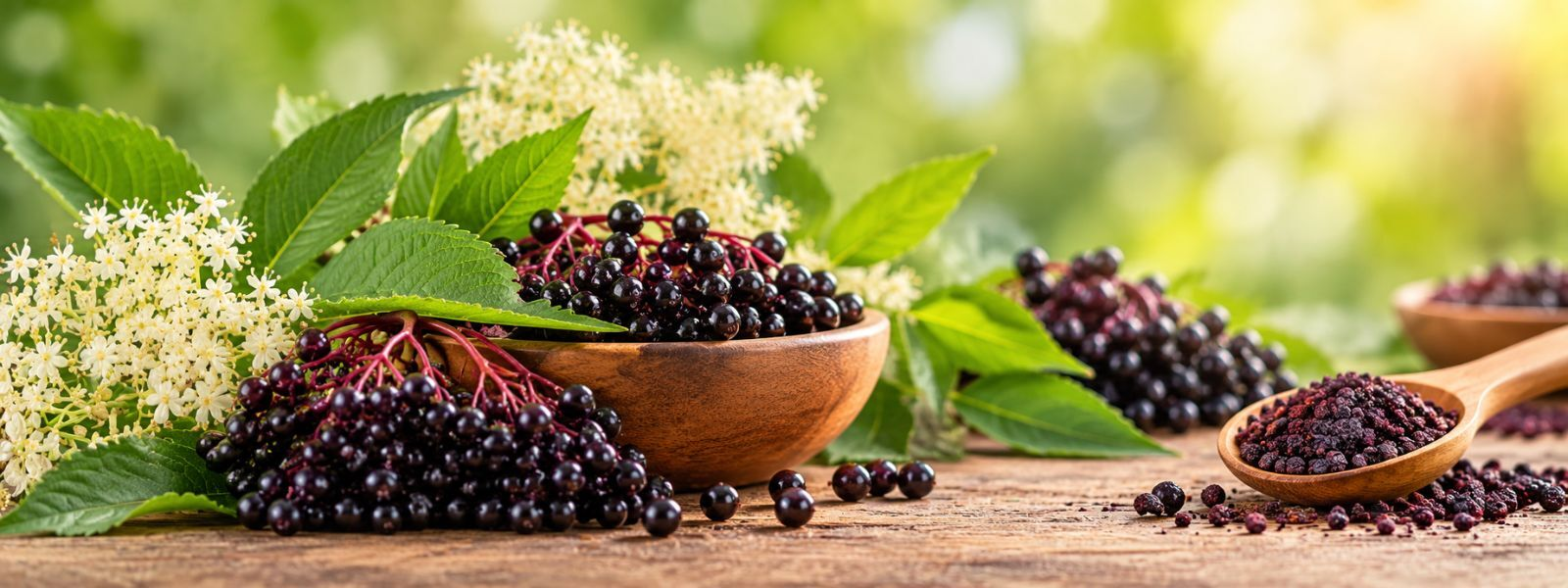
The deep purple color of elderberries comes largely from anthocyanins, a class of polyphenolic compounds with antioxidant activity. Elderberries also contain other flavonoids and polyphenols that have attracted scientific interest.
These compounds don't take the spring and summer off.
Antioxidant activity is relevant to everyday wellness because oxidative processes occur throughout the body year-round. Elderberry's phytochemicals may also support a healthy inflammatory balance.
And there may be another interesting connection: some of the polyphenols found in elderberry may have prebiotic-like effects, providing compounds that can be utilized by beneficial gut microorganisms. One small study found that elderberry polyphenols could influence the growth and activity of certain gut bacteria.
Why does that matter? Our gut microbiome plays an important role in maintaining immune and inflammatory balance, making the gut relevant to overall wellness in every season.
Of course, there's an important distinction between a plausible biological effect and a proven clinical outcome. A laboratory finding doesn't automatically tell us what will happen in a person, and research specifically examining elderberry during pollen season is limited.
Still, the combination of traditional use, phytochemistry, and emerging research gives us plenty of reason to remain curious.
Myth #3: Elderberry is the most antioxidant-rich berry.
Elderberry is an impressive berry, but it isn't necessarily the antioxidant champion.
One of its most interesting competitors is aronia, sometimes called chokeberry. Research comparing different berries has found exceptionally high levels of polyphenols and anthocyanins in aronia, along with strong antioxidant activity.
In one study examining berries including elderberry and aronia, researchers characterized substantial amounts of anthocyanins and other compounds in both. The results helped illustrate an important point: different berries have different phytochemical profiles, and antioxidant activity isn't necessarily the only measure of a valuable botanical.
So perhaps we shouldn't be looking for a single “superberry” that does everything.
Sometimes, a thoughtful combination of botanicals makes more sense.
Elderberry brings its characteristic anthocyanins and other polyphenols, while aronia contributes its own exceptionally rich polyphenol profile. Together, these two berries can provide a broader range of naturally occurring compounds.
Myth #4: Elderberry works best as a preventive.
Here's where the answer gets interesting.
Some of the research surrounding elderberry suggests that its benefits may be most relevant when it is incorporated into a wellness routine before or at the earliest signs of a seasonal challenge.
That idea is biologically plausible and has been explored in clinical research, but it is not yet something we can state with certainty. Read the research and draw your own conclusions.
The challenge is that the studies are relatively few, often small, and have used different elderberry preparations, doses, and study designs.
For now, the evidence is interesting but not definitive.
Myth #5: All elderberry products are basically the same.
Not even close.
“Elderberry” on the front of a label doesn't tell you how much botanical material is actually represented in a serving.
Fresh berries, juice, dried berry powder, and concentrated extracts are not equivalent. Two products can both contain elderberry while providing very different amounts of the plant's naturally occurring constituents.
That's why looking beyond the ingredient name matters.
For consumers and practitioners, some useful questions include:
- What form of elderberry is being used?
- How much botanical material is represented in each serving?
- Is the extract concentrated?
- Are the ingredients tested for identity and quality?
- Is the finished product tested?
- What other botanicals are included?
- What sweeteners and other ingredients are being used?
And “more” isn't necessarily better. A thoughtful botanical formula isn't simply about putting the largest possible amount of one herb into a bottle. It is about choosing appropriate ingredients, concentrations, and combinations.
Myth #6: The Elder Mother will curse you if you harvest elderberries without asking permission.
Finally, we arrive at the myth that science can't really settle.
Across European folklore, the elder tree has long been associated with the mysterious figure known as the Elder Mother. In some traditions, people believed that the Elder Mother lived within the tree and should be treated with respect when harvesting its branches or berries.
Could she actually curse an unsuspecting berry picker?
We don't have a randomized controlled trial on that one.
But there is something surprisingly relevant about the old story.
The folklore reflects an attitude toward plants that modern herbalists and sustainability-minded companies can appreciate: take from nature with respect.
Today, that idea can translate into responsible botanical sourcing, thoughtful packaging, conservation, and giving back to the natural world that provides the raw materials in the first place.
Read more about elderberry folklore and the case for sustainability.
Choosing a Quality Elderberry Product
The growing popularity of elderberry means there are more products to choose from than ever before. For consumers who want to make elderberry part of their wellness routine, quality matters.
Bold Botanica was founded by herbalists who care deeply about providing the quality herbal products they wanted access to themselves. That means creating formulas with a focus on proven potency, thoughtful formulation, and caring for our planet.
Leveraging decades of herbal industry expertise, Bold Botanica formulates with an emphasis on strength, balance, and transparency. The brand uses concentrated botanical extracts with a full-spectrum approach, tests ingredients and batches through third-party laboratories, and identifies bioactive compounds so customers can have a clearer understanding of what they're getting.
Bold Botanica also takes the environmental side of herbalism seriously. The company uses clean, organic, non-GMO, or sustainably grown botanicals, packages products in glass and 100% recycled cartons, and donates 2% of sales to save our forests.
Bold Elderberry Elixir
Bold Elderberry Elixir brings that philosophy to a familiar botanical favorite.
Each one-teaspoon serving provides the equivalent of 18 grams of fresh elderberries, thanks to the concentrated elderberry extract used in the formulation. It combines elderberry with aronia for antioxidant support as part of your wellness routine during any season.
And there's no need to add sugar to make it enjoyable. Bold Elderberry Elixir is sugar-free and sweetened with monk fruit, creating a great-tasting liquid that makes it easy to incorporate elderberry into a daily wellness routine—and a flavor that kids enjoy, too.
For those who prefer a capsule, Bold Elderberry Plus offers another option, combining elderberry and aronia with vitamin C and zinc.
Whether you choose a liquid or capsule, the goal is the same: a thoughtfully formulated elderberry product that delivers concentrated botanical ingredients while keeping quality, transparency, and sustainability in mind.
What Does the Science Really Say?
Perhaps the biggest myth about elderberry isn't any one of these claims.
It's the idea that we already know everything there is to know about it.
We don't.
Elderberry has a long history of traditional use and a growing body of laboratory and clinical research. Studies have identified interesting antioxidant properties and biological activities, while clinical trials have explored elderberry in connection with seasonal respiratory wellness.
At the same time, the current evidence base is limited in both size and quality.
Many of the available human studies have involved relatively small numbers of participants. Different studies have used different elderberry preparations, doses, durations, and outcomes. And while laboratory research can help us understand possible mechanisms, it cannot substitute for well-designed human trials.
That means we should resist both extremes.
Elderberry isn't a miracle cure—and it isn't an herb that should be dismissed simply because every proposed benefit hasn't been definitively proven.
The more interesting position lies somewhere in between: follow the traditional wisdom, investigate the science, acknowledge the limitations, and remain curious about what we have yet to learn.
And perhaps that's exactly how the Elder Mother would have wanted it.