
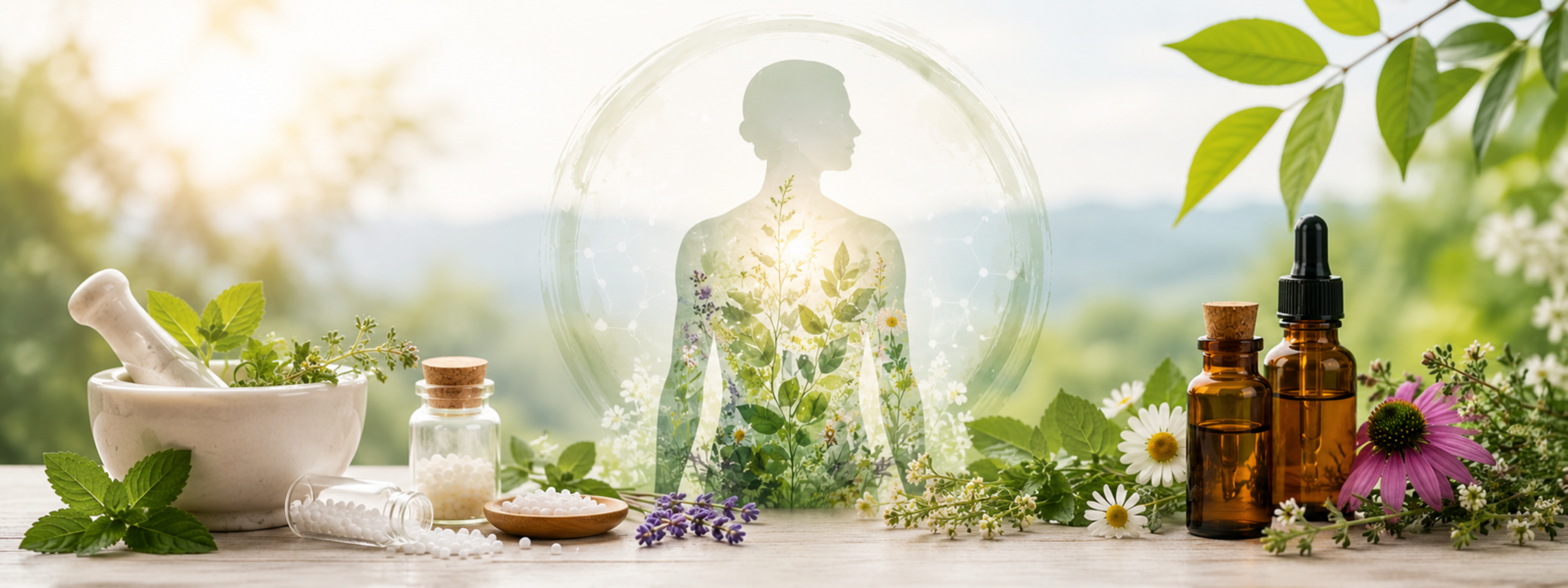
What is Homeopathy?
"The Short Answer": Homeopathy is a system of medicine developed more than 200 years ago by German physician Samuel Hahnemann. Based on the principle of "like cures like," homeopathy uses highly diluted natural substances selected according to an individual's unique symptoms with the aim of supporting the body's self-regulatory and healing processes. Homeopathic practitioners treat the whole person—considering physical, mental, emotional, and constitutional characteristics—rather than focusing solely on a diagnosis. Today, homeopathy is used by millions of people worldwide as a complementary approach to health and wellness, often alongside conventional medical care.
*******
According to the Centers for Disease Prevention and Control’s 2012 National Health Interview Survey, an estimated 5 million adults and 1 million children in the United States use homeopathy. A 2022 Marist Poll found that 61% of U.S. households use vitamins, minerals, supplements, natural or homeopathic remedies daily. Globally, the Homeopathy Research Institute reports that homeopathy is regularly used by more than 200 million people and is included in the national health systems of countries like Brazil, Chile, India, Mexico, and Switzerland.
What Is Homeopathy?
Homeopathy is a system of medicine developed in the late 18th century by German physician Samuel Hahnemann. Frustrated by the harsh medical practices of his era, including bloodletting and toxic mercury compounds, Hahnemann began experimenting with an idea he called the "law of similars". He considered whether a substance capable of producing symptoms in a healthy person could, in a highly diluted form, stimulate the body to heal those same symptoms in a sick person.
The word homeopathy comes from the Greek homoios (similar) and pathos (suffering). Hahnemann published his foundational text, Organon of Medicine, in 1810, and homeopathy spread rapidly across Europe and the United States throughout the 19th century.
The Core Principles
Homeopathic practice rests on three foundational ideas:
- The Law of Similars or "Like cures like": A substance that causes symptoms in large doses can treat similar symptoms in minute doses. For example, caffeine causes insomnia in high amounts; homeopathic practitioners may prescribe a highly diluted caffeine preparation for sleeplessness.
- The Law of Infinitesimals: Remedies are made through a process of serial dilution and vigorous shaking (called succussion). Homeopathic theory holds that the more diluted a remedy, the more potent it becomes, an idea that contradicts conventional pharmacology.
- Individualization: Homeopathy treats the person, not just a disease. Two patients with the same diagnosis may receive different remedies based on their unique physical, emotional, and constitutional profile.
What Homeopathic Remedies Look Like
Remedies are prepared from plant, mineral, and animal sources, such as arnica (a mountain plant), belladonna (deadly nightshade), and sulfur. They are sold as small pellets, liquid drops, tablets, or topical creams, and are labeled with a potency designation such as 6C, 30C, or 200C where "C" refers to centesimal dilutions. A 30C remedy has been diluted one part in a hundred, thirty times over.
How Does Homeopathy Work?
Homeopathic practitioners explanation
Homeopathic practitioners generally view remedies as stimulating the body's innate self-regulatory or self-healing capacity, rather than directly suppressing symptoms or replacing deficient substances.
In this model:
- The remedy acts as a highly specific biological signal.
- The body recognizes that signal.
- Adaptive regulatory mechanisms are activated.
- The organism moves toward restoring balance (homeostasis).
Rather than "fighting disease," the remedy is intended to support the body's own healing response.
What emerging scientific hypotheses are being investigated
- Water memory: The hypothesis, first proposed by French immunologist Jacques Benveniste in 1988, suggests that water molecules can retain structural information from dissolved substances even after those substances are gone.
- Nanoparticle theory: Some studies have reported that homeopathic manufacturing may leave nanoparticles or nanostructures derived from the original source material or the container. These could potentially have biological activity even at extremely low concentrations.
- Energetic or bioenergetic effects: At the center of this model is the vital force, described as a nonmaterial, dynamic organizing principle that sustains life, regulates the body, and supports adaptation and self-healing. In classical homeopathic philosophy, health exists when this vital force is balanced, while illness begins when it becomes disturbed by factors such as stress, trauma, infection, or environmental influences.
Is Homeopathy Safe?
The Case for a Strong Safety Profile
At the dilution levels used in classical homeopathy (30C and above), the direct toxicological risk from a homeopathic remedy when taken as directed is extremely low. Similarly, for most highly diluted homeopathic remedies (30C and above), direct pharmacological interaction with conventional drugs is unlikely because there is no measurable active substance present.
Practical Steps to Take
The National Center for Complementary and Integrative Health recommends the following when considering the use of homeopathic products:
- Do not replace or postpone conventional care with homeopathy. Homeopathic remedies are not substitutes for vaccines.
- Bring homeopathic products to your next medical appointment. Your physician or pharmacist can review the ingredients and potency and advise on potential interactions or concerns.
- Disclose complementary therapies to every member of your care team. Studies show that many people using complementary therapies like homeopathy do not tell their conventional doctors, which may create unnecessary risk.
- Be cautious if you are pregnant, breastfeeding, managing a chronic illness, or giving homeopathic products to children; consult with your primary care provider.
In addition, check the potency designation of homeopathic remedies before taking them. Higher dilutions (30C, 200C) have a strong safety record and carry lower interaction risk than lower dilutions (1X to 6X).
Homeopathy Alone or as Part of an Integrative Approach?
An analysis of the 2012 National Health Interview Survey in the American Journal of Public Health found the majority of adults who use homeopathic products self-prescribe them and integrate their use with other medical and wellbeing modalities.
The Case for Integration
A 2020 German observational, comparative study of more than 2,500 participants of which more than 1,500 integrated homeopathy in their care. After six months, the group that integrated homeopathy had statistically significant improvements over the conventional care group in the treatment of headaches, asthma, and atopic dermatitis, and minimal improvement in the treatment of depression. Another German comparative study of more than 15,000 insured patients treated with homeopathy over a three-year period needed fewer conventional drugs than an equally large group that did not receive homeopathic care.
The 2012 French study published in Pharmacoepidemiology and Drug Safety compared clinical progression, drug consumption, side effects and loss of therapeutic opportunity of more than 1,100 participants with musculoskeletal disorders over 12 months. The participants were included in one of three groups based on their physicians’ practice modality: homeopathy; integrated practice; or conventional medicine. The patients treated with homeopathy used almost half the amount of nonsteroidal anti-inflammatory drugs (NSAIDs), like ibuprofen and naproxen, than the conventional medicine group and about the same amount as the integrative therapies group. The authors concluded that patients treated by homeopathic physicians showed a similar clinical progression, used about half the amount of non-steroidal NSAIDs compared with conventionally-treated patients, had fewer NSAID-related adverse events, and experienced no loss of therapeutic opportunity.
How Integrative Practitioners Approach It
Skilled integrative practitioners, including integrative physicians, naturopathic doctors, and functional medicine doctors, may view homeopathy as a tool, one that may address dimensions of a patient's experience that pharmaceuticals do not reach: emotional symptoms, constitutional tendencies, quality of life, and the body's own healing capacity.
- Homeopathy Use in the United States. (Updated April 2021). National Center for Complementary and Integrative Health. https://www.nccih.nih.gov/health/homeopathy
- Marist Poll (Sep 2022). U.S. households use of vitamins, minerals, or other dietary supplements or other natural or homeopathic remedies. chrome-extension://efaidnbmnnnibpcajpcglclefindmkaj/https://www.npanational.org/wp-content/uploads/2022/10/Marist-Poll-Results-1.pdf
- Homeopathy use around the World. (Jul 2026). Homeopathy Research Institute. https://www.hri-research.org/resources/essentialevidence/use-of-homeopathy-across-the-world/
- Maddox, J. (1988). Waves caused by extreme dilution. Nature. https://doi.org/10.1038/335760A0. https://www.academia.edu/10286319/Waves_caused_by_extreme_dilution
- Goyai, S., et al. (Oct 2025). Homeopathic Medicine: An Intrinsic Nanomaterial for Synthesis of AgNPs for Environmental and Biomedical Applications. ACS Omega. https://pubs.acs.org/doi/10.1021/acsomega.5c04977
- Kelly, J.M., et al. (Apr 2014). The Influence of the Patient-Clinician Relationship on Healthcare Outcomes: A Systematic Review and Meta-Analysis of Randomized Controlled Trials. PLOS One. https://journals.plos.org/plosone/article?id=10.1371/journal.pone.0094207
- Wassef, K., et al. (Feb 2025). Measuring the quality of patient-provider relationships in serious illness: A scoping review. Palliative Medicine. https://pmc.ncbi.nlm.nih.gov/articles/PMC11877987/
- National Health and Medical Research Council (Australia). (2015). Evidence on the effectiveness of homeopathy for treating health conditions. chrome-extension://efaidnbmnnnibpcajpcglclefindmkaj/https://www.hri-research.org/wp-content/uploads/2015/07/NHMRC-Information-Paper-Mar2015.pdf
- National Center for Complementary and Integrative Health (NCCIH). (Last Updated: April 2021). Homeopathy: What You Need To Know. https://www.nccih.nih.gov/health/homeopathy
- Shang A, Huwiler-Müntener K, Nartey L, Jüni P, Dörig S, Sterne JA, Pewsner D, Egger M. Are the clinical effects of homoeopathy placebo effects? Comparative study of placebo-controlled trials of homoeopathy and allopathy. Lancet. 2005 Aug 27-Sep 2;366(9487):726-32. doi: 10.1016/S0140-6736(05)67177-2. https://pubmed.ncbi.nlm.nih.gov/16125589/
- Rieder MJ, Robinson JL. 'Nosodes' are no substitute for vaccines. Pediatric Child Health. 2015 May;20(4):219-22. doi: 10.1093/pch/20.4.219. PMID: 26038642; https://pmc.ncbi.nlm.nih.gov/articles/PMC4443832/
- Posadzki P, Alotaibi A, Ernst E. Adverse effects of homeopathy: a systematic review of published case reports and case series. Int J Clin Pract. 2012 Dec;66(12):1178-88. doi: 10.1111/ijcp.12026. https://pubmed.ncbi.nlm.nih.gov/23163497/
- Dossett ML, Davis RB, Kaptchuk TJ, Yeh GY. Homeopathy Use by US Adults: Results of a National Survey. American Journal of Public Health. 2016 Apr;106(4):743-5. doi: 10.2105/AJPH.2015.303025. Epub 2016 Feb 18. https://pmc.ncbi.nlm.nih.gov/articles/PMC4816083/
- Kass, B. et al., Effectiveness and cost-effectiveness of treatment with additional enrollment to a homeopathic integrated care contract in Germany. BMC Health Serv Res 2020 Sep 15;20(1):872. https://pubmed.ncbi.nlm.nih.gov/32933511/
- https://www.securvita.de/fileadmin/inhalt/dokumente/auszuege_SECURVITAL/202004/securvital_0420_6-11.pdf?fbclid=IwAR0h1r24c9lMBoneQ7S7kF2aNVwGPDaM4zHdoFLt2Q_eU_UNd3qbI9fG380
- Why Homeopathy Matters to U.S. Healthcare. (2026). American Institute of Homeopathy. https://homeopathyusa.org/why-homeopathy-matters-to-u-s-healthcare/
Rossignol M, Begaud B, Engel P, et al. Impact of physician preferences for homeopathic or conventional medicines on patients with musculoskeletal disorders: results from the EPI3-MSD cohort. Pharmacopepidemiol. Drug Saf. 2012, 21:1093-101. https://pubmed.ncbi.nlm.nih.gov/22782803/
- Therapeutic Applications for Homeopathy in Clinical Practice, PubMed Central, 2025
- An Analysis of Four Government-Funded Reviews of Research on Homeopathy, PubMed Central, 2021
- Australian Government Natural Therapies Review 2024: Homeopathy Evidence Evaluation
- Homeopathy Use by U.S. Adults: Results of a National Survey, PubMed Central
- FDA Guidance: Homeopathic Drug Products
- American Institute of Homeopathy: Why Homeopathy Matters to U.S. Healthcare
- https://www.hri-research.org/hri_publication/homeopathy-medicine-or-magic/
- https://video.alexanderstreet.com/watch/homeopathy-medicine-or-magic