
Is the Interstitium a New Organ and the Key to Understanding Ancient Medicine?
The Body Has Always Been More Connected Than Western Anatomy Admitted
Seeing Acupuncture’s Energy Pathways Through the Lens of Modern Connective Tissue Science
When researchers examined tattooed skin biopsies in 2021, they expected to find ink confined to the upper dermis. Instead, ink particles had traveled far deeper than anticipated, threading through layers of connective tissue into the underlying fascia. Neil Theise, MD, a professor of pathology at New York University and senior author of the study published in Communications Biology, simply remarked. "That wasn't supposed to happen."
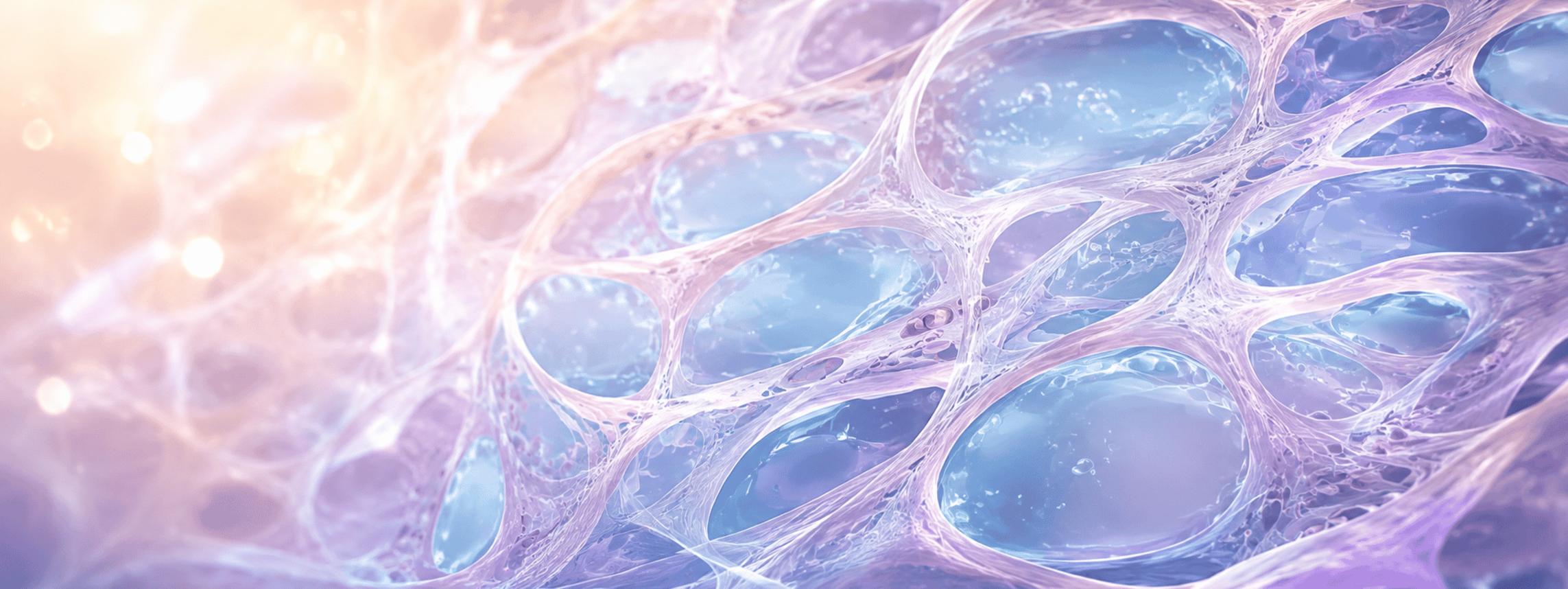
What that unexpected migration revealed was not an anomaly. It was a window into one of the most significant anatomical rediscoveries of modern medicine: the interstitium, a body-wide, fluid-filled connective tissue network that may fundamentally change how we understand human physiology.
Key insight: The interstitium makes up as much as 20% of the body’s total fluid volume but remained largely unnoticed by Western medicine for centuries because standard tissue-preparation methods collapsed its structure before it could be seen.
This discovery has special significance for practitioners of integrative and whole-health medicine. The interstitium may be the biological explanation for concepts that Traditional Chinese Medicine (TCM) has described for over 4,000 years. The body has always been more intricately connected than Western anatomy has acknowledged.
What Is the Interstitium?
For most of modern medical history, the spaces between cells and organs were treated as unremarkable structural filler. That view began to shift in 2018, when a paper in Scientific Reports described the interstitium as a continuous, three-dimensional network distributed throughout the human body. These fluid-filled spaces form an integrated system embedded within and between every major tissue type.
The Architecture: Collagen and Hyaluronic Acid
The interstitium is built from two complementary components:
- Collagen scaffolding: Bundles of collagen fibers provide structural strength and tensile resistance, forming a framework that holds the network together across tissue boundaries.
- Hyaluronic acid matrix: A viscous, gel-like substance rich in hyaluronic acid fills the spaces between collagen fibers, retaining water and allowing fluid to move slowly through the tissue.
One way to visualize this is a sheet of chicken wire (collagen) surrounded by a thick, water-soaked sponge (hyaluronic acid gel). Fluid does not rush through this system the way blood moves through arteries. It percolates, carrying molecules, signaling compounds and cells as it goes.
Three Scales of Interstitial Space
Research published in Frontiers in Physiology in 2026 identified three distinct levels of interstitial organization within the fascial-interstitial system:
|
Interstitium Level |
Location |
Scale |
|
Fascial |
Around organs, within fascia |
50-500 micrometers |
|
Perivascular |
Surrounding blood vessels |
5-50 micrometers |
|
Intercellular |
Between adjacent cells |
Less than 1.5 micrometers |
Together, these three scales form a single, body-wide network. The 2021 continuity study in Communications Biology used both tattoo pigment and hyaluronic acid staining to trace interstitial connections across the colon, skin, and liver, demonstrating that these spaces are not confined within individual organs but extend continuously between them.
This is the critical shift: Connective tissue is not packaging. It is a communication infrastructure.
A Proposed Third Circulatory System
Rebecca Wells, MD, a professor of medicine at the University of Pennsylvania and a collaborator on the continuity research, described the interstitium as supporting the idea of "a third system for the circulation of fluids" in the body, operating alongside the cardiovascular and lymphatic systems.
The cardiovascular system moves blood under pressure. The lymphatic system collects interstitial fluid and returns it to circulation while supporting immune function. The interstitium provides a slow, pervasive transport medium through which fluid, immune cells, and signaling molecules can migrate across tissue boundaries in ways that neither the blood nor lymph systems can accomplish on their own.
The numbers make this significant. Research estimates that interstitial fluid volume in the body exceeds the combined fluid volume of the cardiovascular and lymphatic systems by more than three times. A system holding that much fluid, connecting every organ and tissue type, cannot be treated as passive filler.
What the Interstitium Transports
The extracellular matrix of interstitial spaces supports several active functions beyond fluid movement:
- Cell migration: The interstitium directs the movement of immune cells (lymphocytes) through tissue when inflamed.
- Molecular signaling: Signaling compounds diffuse through interstitial pathways in ways that operate both in parallel with and independently of the vascular system.
- Mechanotransduction: Physical forces applied to the body, such as compression, stretching, or needle insertion, are transmitted through the collagen-hyaluronic acid matrix and may trigger biochemical responses at a distance.
- Disease dissemination: Research has shown that tumor cells can exploit interstitial pathways to migrate across organ boundaries, with implications for understanding cancer metastasis.
The interstitium does not replace the cardiovascular or lymphatic systems but complements, and may help coordinate, them.
The Bridge to Traditional Chinese Medicine
This discovery holds particular interest for traditional and integrative medicine practices.
For over 4,000 years, TCM has described qi (also written as "chi") flowing through 12 primary meridian channels that traverse the body, connecting surface acupuncture points to internal organs. Western medicine has often viewed this framework metaphorically, not anatomically because no physical structure corresponding to meridians had ever been identified under a microscope. The interstitium changes that conversation.
The Tracer Evidence
In a 2024 study published in Frontiers in Physiology, reseachers injected fluorescent dye into acupuncture points PC5, PC6, and PC7 on the pericardium meridian of the forearm in 15 healthy volunteers. In 15 of 19 participants at PC6, the dye migrated proximally along a linear path that closely matched the TCM-defined pericardium channel, arriving at acupoint PC3. Injections at adjacent non-acupoint control sites produced no such linear pathway.
Ultrasound imaging confirmed that the dye's trajectory aligned with intermuscular fascia, not with any known blood or lymphatic vessel. The fluid was moving through the interstitium.
A 2002 mapping study published in The Anatomical Record found an 80% overlap between acupuncture points and the locations of intermuscular or intramuscular connective tissue planes. This relationship may explain acupuncture’s mechanism of action from needles placed along connective tissue planes and intersections, and the potential role of the interstitium in sending out signals from such placement.
The TCM-Interstitium Hypothesis
A 2026 systematic review in Frontiers in Physiology took this further, conducting a comparative analysis of classical TCM’s passageway for qi and body fluids, known as the San Jiao-Mocou system, against contemporary literature on the fascial-interstitial system. The study concluded that the San Jiao-Mocou system shares core structural and functional attributes with the fascial-interstitial system, including its body-wide distribution, fluid-transport role, and function in systemic communication and homeostasis.
The study’s authors concluded, "[The result of the study] offers a potential anatomical framework for understanding meridians and opens new avenues for interdisciplinary research in biomechanics, fluid dynamics, and integrative physiology."
This does not mean that qi and interstitial fluid are identical. It means that the anatomical substrate for meridian-based healing may have been present all along, simply invisible to the tools Western medicine had been using to look.
Acupuncture, Yin Yoga, and the Fascial-Interstitial System
Understanding the interstitium reframes two of the most widely practiced integrative therapies—acupuncture and yoga.
How Acupuncture May Work Through the Interstitium
When an acupuncture needle is inserted and rotated, it does not simply pierce tissue; it engages with the tissue mechanically. Research published in the FASEB Journal in 2001 demonstrated that connective tissue winds around the needle, creating a tight mechanical coupling. Further rotation or movement of the needle then deforms the surrounding connective tissue, transmitting a mechanical signal into the fascial-interstitial network.
This mechanical effect may explain acupuncture’s influence beyond the insertion point. The signal travels not only travels through nerves, but through the physical deformation of a continuous, body-wide connective tissue matrix.
For practitioners and patients exploring acupuncture as an integrative therapy, this offers a scientific explanation for how acupuncture may work.
Yin Yoga and Fascial Loading
Yin yoga is distinctive among yoga styles in its emphasis on long-held postures, typically two to five minutes, that target connective tissue rather than muscle. Unlike more dynamic practices that primarily engage muscle fibers, Yin yoga applies sustained compressive and tensile load to fascia, ligaments, and the deep connective tissue layers where interstitial fluid moves.
Yin yoga was developed explicitly in dialogue with TCM principles, understanding the fascia as the physical medium through which meridian pathways run. From an interstitial perspective, the long holds may promote fluid movement through fascial planes, support mechanical signaling, and influence the hydration state of the hyaluronic acid matrix that keeps connective tissue pliable and functional.
The practice connects directly to the KnoWEwell principle of Regenerative Whole Health, that the body's systems are not isolated modules but an integrated, communicating whole. Understood through the lens of the interstitium, Yin yoga is not stretching, it is circulation.
Clinical Implications
The rediscovery of the interstitium has clinical implications beyond anatomy.
Inflammation and Immune Signaling
The interstitium is a highway for lymphocyte migration during inflammatory responses. If interstitial fluid flow is impaired, whether through dehydration, fascial restriction, sedentary behavior, or chronic tension, immune cells may not move efficiently through tissue. This has potential relevance for chronic inflammatory conditions, autoimmune responses, and recovery from injury or illness.
Cancer Metastasis
The 2021 study published in Communications Biology confirmed that tumor cells can exploit interstitial pathways to spread across organ boundaries. Understanding how cancer cells navigate the interstitial matrix may open new avenues for targeted therapies that disrupt that migration.
Metabolic Health
The behavior of interstitial cells during adipose tissue (fat tissue) expansion may influence metabolic regulation. A 2025 narrative review published in Biomedicines suggests there are connections between adipose tissue dysregulation and Type 2 diabetes progression.
A Framework for Integrative Practice
From a whole-health perspective, the interstitium offers proof that the body does not operate as a collection of isolated organ systems. Every tissue is connected to every other tissue through a continuous fluid-filled matrix and integrative medical practices are designed to capitalize on this system.
|
Practice |
Interstitial Mechanism |
|
Acupuncture |
Mechanotransduction through needle-connective tissue coupling; fluid movement along fascial planes |
|
Yin yoga |
Sustained fascial loading promoting fluid circulation and connective tissue hydration |
|
Manual therapy / massage |
Compression and release of fascial interstitium, supporting fluid drainage and mobility |
|
Movement and exercise |
Dynamic fascial loading that promotes interstitial fluid flow throughout the body |
|
Chiropractic techniques |
Therapies directly target interstitial fluid and the connective tissue network to relieve pain and improve range of motion such as myofascial release, instrument-assisted soft tissue manipulation, and lymphatic and interstitial drainage |
For those engaged in Regenerative Whole Health, the interstitium is more than a new anatomical structure. It is a confirmation of something that traditional healing practices have always understood, that health is not the sum of isolated parts functioning in parallel, but the quality of communication and flow between them.
More research is needed to fully characterize how interstitial flow influences specific disease processes, how it responds to different therapeutic interventions, and how its function changes across the lifespan.
Explore integrative practitioners, acupuncture specialists, and whole-health resources at KnoWEwell, a global platform connecting individuals and families with vetted practitioners in functional, integrative, and natural medicine.
- Benias, P.C., Wells, R.G., Sackey-Aboagye, B., et al. (2018). Structure and distribution of an unrecognized interstitium in human tissues. Scientific Reports, 8, 4947. https://doi.org/10.1038/s41598-018-23062-6
- Cenaj, O., Allison, D.H.R., Imam, R., Theise, N., et al. (2021). Evidence for continuity of interstitial spaces across tissue and organ boundaries in humans. Communications Biology, 4, 436. https://pmc.ncbi.nlm.nih.gov/articles/PMC8012658/
- Langevin, H.M., & Yandow, J.A. (2002). Relationship of acupuncture points and meridians to connective tissue planes. The Anatomical Record, 269(6), 257-265. https://onlinelibrary.wiley.com/doi/10.1002/ar.10185
- Shi, X., et al. (2024). An acupoint-originated human interstitial fluid circulatory network. Frontiers in Physiology. https://pubmed.ncbi.nlm.nih.gov/39381647/
- Zhang, W., et al. (2026). The fascial-interstitial system and the Sanjiao-Mocou system: A comparative analysis bridging TCM theory and contemporary biomedical science. Frontiers in Physiology. https://www.frontiersin.org/journals/physiology/articles/10.3389/fphys.2026.1795656/full
- Ahn, A.C., Colbert, A.P., Anderson, B.J., et al. (2008). Electrical properties of acupuncture points and meridians: A systematic review. Bioelectromagnetics, 29(4), 245-256.
- Langevin, H.M., Churchill, D.L., & Cipolla, M.J. (2001). Mechanical signaling through connective tissue: A mechanism for the therapeutic effect of acupuncture. FASEB Journal, 15(12), 2275-2282.
- Rausch, J., et al. (2025). The Effects of Adipose Tissue Dysregulation on Type 2 Diabetes Mellitus. Biomedicines. https://pmc.ncbi.nlm.nih.gov/articles/PMC12292160/